

Most of you read this in your inbox or on the Substack app. Please consider sharing this post, hitting the heart button 💛, and/or restacking it on Substack to help it find others that would be encouraged and grow our community.
If this is wobbly, it’s because I’m writing in a Benadryl-induced haze thanks to the prolific pine pollen coating every surface around my North Florida cottage. Something happened this week that was not on my 2026 bingo card…
A few days ago I noticed two screens in my soffits were disturbed. When I went to repair them, we found out there was a raccoon that had moved in. Given the time of year, likely she was a mama-to-be looking for a safe den.
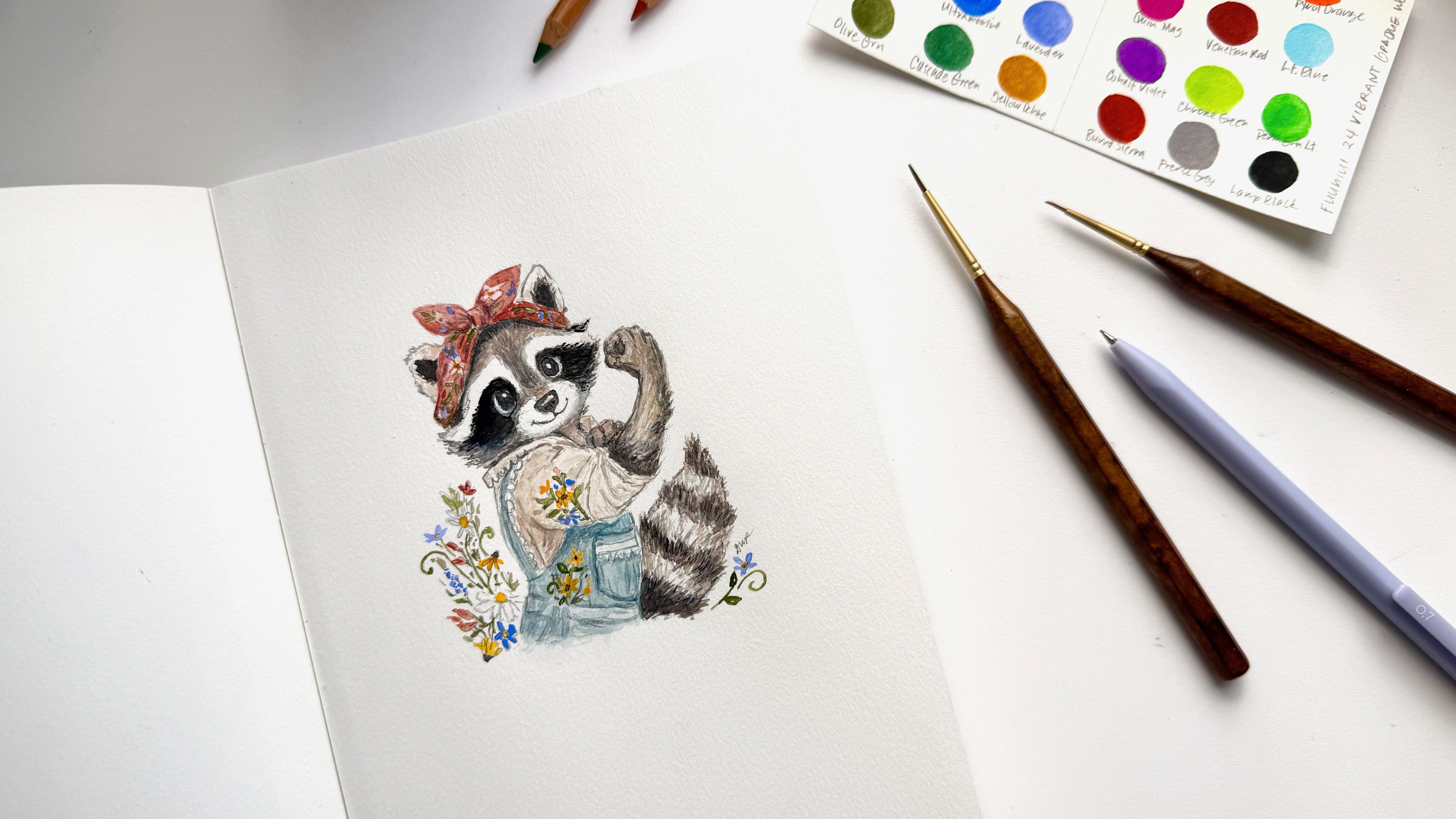
A raccoon nursery… in my attic. 🦝 It sounds like a story book. So of course, I had to name her. Meet Rosie the Raccoon.
I see the world through the lens of metaphor. You might call it an occupational hazard of being a writer. When something completely unexpected happens (a la raccoon nursery in my attic), I pause to listen deeper to see if there might be a lesson waiting.
Allow me to share for a moment what incredible creatures raccoons are.
Raccoons explore the world with their hands. Their curiosity guides nearly everything they do. I suspect this masked mama might illustrate something I’ve been thinking about a lot lately.
When the world feels uncertain, curiosity becomes one of the most powerful ways to move forward.

Raccoons are the poster children for embodied curiosity.
I’m literally in the middle of researching and writing about curiosity for my book, and it turns out that Rosie could be this section’s mascot.
Raccoons “see” the world through touch. 2/3rds of a raccoon’s brain is dedicated to processing tactile information. When they “wash” their food, they are wetting down their hands to make them more sensitive to touch and thus gain additional information.
They rival primates in their intelligence. Raccoons can remember things for years and are capable of observational learning. That means they can learn things by watching other raccoons do them. They also practice trial-and-error adaptibility with high levels of problem-solving.
Raccoon mamas are fierce protectors of their babies. Male raccoons will find dens and destroy the young so the females will go back into heat. Which is why I’ve had to spend so much to secure the rest of my soffits. The mamas will also move the kits multiple times if necessary to keep them safe.
Raccoons exist in the liminal spaces on the edges of things between the wild and the human world. They move in the dark and twilight hours.
Raccoons investigate the unfamiliar and adapt accordingly. They explore overlooked spaces (like my attic) and inhabit the margins. The personification of resilience and persistence, raccoons look at a world of obstacles and keep finding alternate openings, unexpected shelters, and overlooked resources.

Rosie reminds us curiosity is a survival skill in an age of uncertainty.
All this goes even deeper. Raccoons are considered boundary walkers in some folklore story traditions. Boundary walkers are characters that teach us how to navigate complexity and can be considered an archetype of creativity.
Because they make sense of the world through touch, raccoons speak to me of the importance of embodied curiosity in a world of volatility, information overload, and chronic disconnection.
When the world feels uncertain, curiosity becomes how we feel our way through the dark.
My relationship with my injured brain changed when I stopped railing at its deficits and leaned into curiosity. That didn’t mean I wasn’t frustrated. It just meant I allowed my frustration to be a cue for curiosity rather than contempt.
Curiosity is the first part of The Wonder Habit®’s wonder wheel. Because Curiosity is the entry point that makes Connection, Courage, Creativity, and Compassion possible.
The curiosity I am referring to in this context isn’t just intellectual or abstract. It is embodied exploration. It is tactile and adaptive. And it is a function of our attention being intentionally engaged rather than extracted by our screens.
Raccoons thrive because of their curiosity and investigation of apparent obstacles. They remind us that we can be shaped by the practice of leaning toward what we do not yet fully understand.
Curiosity is the refusal to let the surface of things be all we see. It reminds us to stop moving through life as if everything is already settled and the story we are living through written in stone. We don’t have to settle for the shape of things as they are.
Curiosity helps us reclaim both our agency and our attention in a timeline that wants to control both. And as such it is in itself an act of beautiful resistance.
Wonder is participatory, not passive. It doesn’t float down from the ceiling unsolicited. Wonder invites us to explore a bigger, better story. And that bigger story can be held in tiny moments where we let our curiosity unlock new ways of being in the world.
Case in point, my attic still needs to be repaired. Rosie’s relocation still costs a lot of money. As in $4000 a lot of money. It has been inconvenient and disruptive.
Wonder doesn’t pretend hard things aren’t hard. But the practice of wonder can change the way we see the world in the middle of hard things.
So that is why you find me turning Rosie into an adorable illustration. Why I did a deep dive into raccoon facts and folklore. I am relentlessly determined to excavate the good that is buried in the hard.
Anne Lamott famously said, “You own everything that happened to you. Tell your stories. If people wanted you to write warmly about them, they should have behaved better.”
In seasons of instability, it is easy to cope by grasping for anything that feels like certainty. Even when that certainty is false or manipulative.
Psychologists call this the need for “cognitive closure.”1 Our brains do not like ambiguity. They interpret it as a threat signal.
When uncertainty rises, we are likely to seize the first plausible explanation we find, freeze that into a belief system, and resist new information. Cognitive researchers refer to this dynamic as “seizing and freezing.”
It can make us susceptible to misinformation, manipulation, rigid thinking, and increased polarization. Succinctly, it makes us easier to control.
The antidote? Cultivating curiosity. Because curiosity allows our brains to approach uncertainty rather than avoid it.
Instead of treating ambiguity purely as a threat, curiosity reframes the unknown as information to explore. Simply put, this activates learning circuits in our brain and keeps us thinking rather than reacting. Curiosity helps us refuse to flatten the world around us and reduce it to that which makes us most comfortable.
Curiosity feels like a vital part of being able to traverse our current landscape. Which is why I’m writing a book. 😉
Let me leave you with this:
What if the most stabilizing thing right now is not finding greater certainty but cultivating deeper curiosity?
Just like raccoons can see the world through their hands in the middle of the night, curiosity can help us find our way through the dark.
Here are two practical things to try.
Instead of doomscrolling and numbing your feelings, practice curiosity by interviewing one big emotion like you are an investigative reporter. Grab your reporter’s notebook (or the back of an envelope) and ask that emotion questions. Where did it come from? What does it want you to know? Etc. Then answer your questions as that emotion.
Curiosity isn’t an abstract intellectual exercise. Pick something to learn as a tactile learner. For example, instead of just studying about Monet in an art book, read his letters. Paint studies of his paintings. Take your art materials and find your Giverny.
So tell me, what are you curious about right now? In what ways has curiosity helped you move through challenges in the past?
🪷 Some new things are blooming around here for spring…
I’m trying out a new Substack schedule for spring and I’m so excited to share more writing and encouragement with you throughout the week. And provide a space for greater connection.
Y’all KNOW I love a good prompt. But I am deeply aware prompts can feel like homework and in our current event timeline, we do not need one more thing to do or feel behind on. So here are the changes I’m experimenting with this spring in hopes of serving you better.
Monday: A longer form essay like this one (Free)
Wednesday: Wildcard mix of content (Free)
Thursday: Reviving our #DearCreatives series. (Free)
Saturday: 100 Days of Wonder content during the challenge (Free)
Sunday: Prompt & Ponder, our paid weekly wonder drop that is a mix of wonder prompts, seasonal creative practices, the audio of me reading select essays from the week with impromptu commentary, a weekly community conversation post, and other periodic surprise downloadable goodies. (Paid)
It’s an ambitious schedule. But I’ve never been great at moderation. So in this case, I’m all in.
If this sounds good, please consider subscribing and sharing this to help me get the word out. I am so grateful you are here.
We all have a part to play in the days we are in. Helping you be more creative, feel less alone, find wonder every day is mine.
All my love

,
https://psycnet.apa.org/buy/1996-01742-003
Thanks so much for writing about curiosity. I used to teach an introduction to social work class, and I always stressed that one of the most important qualities a social worker should have is curiosity. Imagine if people approached their lives with curiosity and wonder! Thanks for helping to show the way to living that kind of life.
You definitely have a gift and I hope to see your work published someday!