

When we consume tweet-length content as our mainstay, our very capacity for depth of language and thought gets cut off and caged in a 280-character count. Increasingly, the content we are exposed to every day is 2-inch-deep, vapid, soul-crushing AI-generated sludge. Distraction at scale is the brain drain of our times.

Honestly, the flattening effect of short-form media crept up on me. I didn’t even realize it was happening until I tried to craft something longer than an Instagram caption. Suddenly structuring a thesis and stating my points felt more like high-altitude rock climbing than writing.
One of the ways I got my words back post-TBI was by studying copywriting. This discipline gave me tools to research and find the words that lived in my audience’s head—as well as my own. I will always be grateful for that.
But copywriting is often short, conversational, and crafted to be pithy, almost to a fault. It is designed to hook you, but it only dives deep enough to get you to take the next desired action. Scroll down the page. Click the button. You know what copywriting doesn’t do well at all? Write a spacious, engaging book with depth of soul. Literary writing is a completely different world.
Since embarking on this writing adventure, I have come face-to-face with my own verbal inadequacies. Writing has felt like an exercise in squeezing ink from a rock. For over a year I have stared at my screen willing words to come that have simply refused to enter the stage on cue. Rude. (But it’s not the word’s fault. Not really.)
I’ve been quieter here because I have been trying to find the way back to my literary voice. And I’ve had to deep dive into reclaiming my own attention just to write about the importance of… reclaiming our attention. 🤣
One of the most vital things I’ve done to get my attention back has been to return to what was once a daily anchor for me: reading physical books and writing by hand in a notebook. My life unfolded in page after page of handwritten journals, starting when I was 15 through my 30s in Africa.
But when I returned to the US in 2013, I stopped writing. It was a devastating move, and I no longer trusted my voice to have anything worth saying. Then came the brain injury that took my words. So for the last decade there have been only scant scribbles and spurts stretched across a very few notebooks.
Sue Monk Kidd writes, “Writing is more than creating language and story. It also involves the creation of self.”
It takes attention to create anything—especially your own becoming.
Personally, I would rather not live in a world of 30-second soundbites where my attention gets auctioned to the highest bidder. I’m going to venture maybe you don’t either.
I want to be crystal clear about the dynamics that are at play. We live in an economy that is built to extract our attention and keep us scrolling (and spending).
Reclaiming that attention may be simple, but that doesn’t mean it is easy. It is not one-and-done, a box we check off, or a level we attain. It is rather an ongoing practice and an intentional posture we maintain.
What Attention Is & Why It Is Vital, Especially in an Age of Algorithms
The English word attention is derived from the Latin root attentio, meaning to stretch towards, as in active mental effort or focused concentration. The word also came to mean care and consideration. Taking back my attention has been one of the most important and stretching things I have ever done—pun completely intended.
When our attention gets fragmented, we are literally being stretched thin. Attention has a finite capacity. It can be exhausted and fatigued. And, as such, it requires care to protect and replenish.
In addition to our feeds and algorithms, navigating this new landscape of AI-everything adds a level of complexity to things. Whether we recognize it or not, AI writing has become utterly pervasive and ubiquitous on the internet.1 It is woven into online advertising, emails, scripts for YouTube videos, social media accounts, and sadly, even some books. AI is dramatically scaling the amount of content we have to sift through online which adds even more strain to our attention resources.
In the days ahead, it will be increasingly vital to not only know how to steward our focus but also how to recognize AI content and manipulation. Our democracy, freedom, and sanity may very well depend on it.
How to Get Your Attention Back, Even If You Can’t Move to a Cottage in the Woods
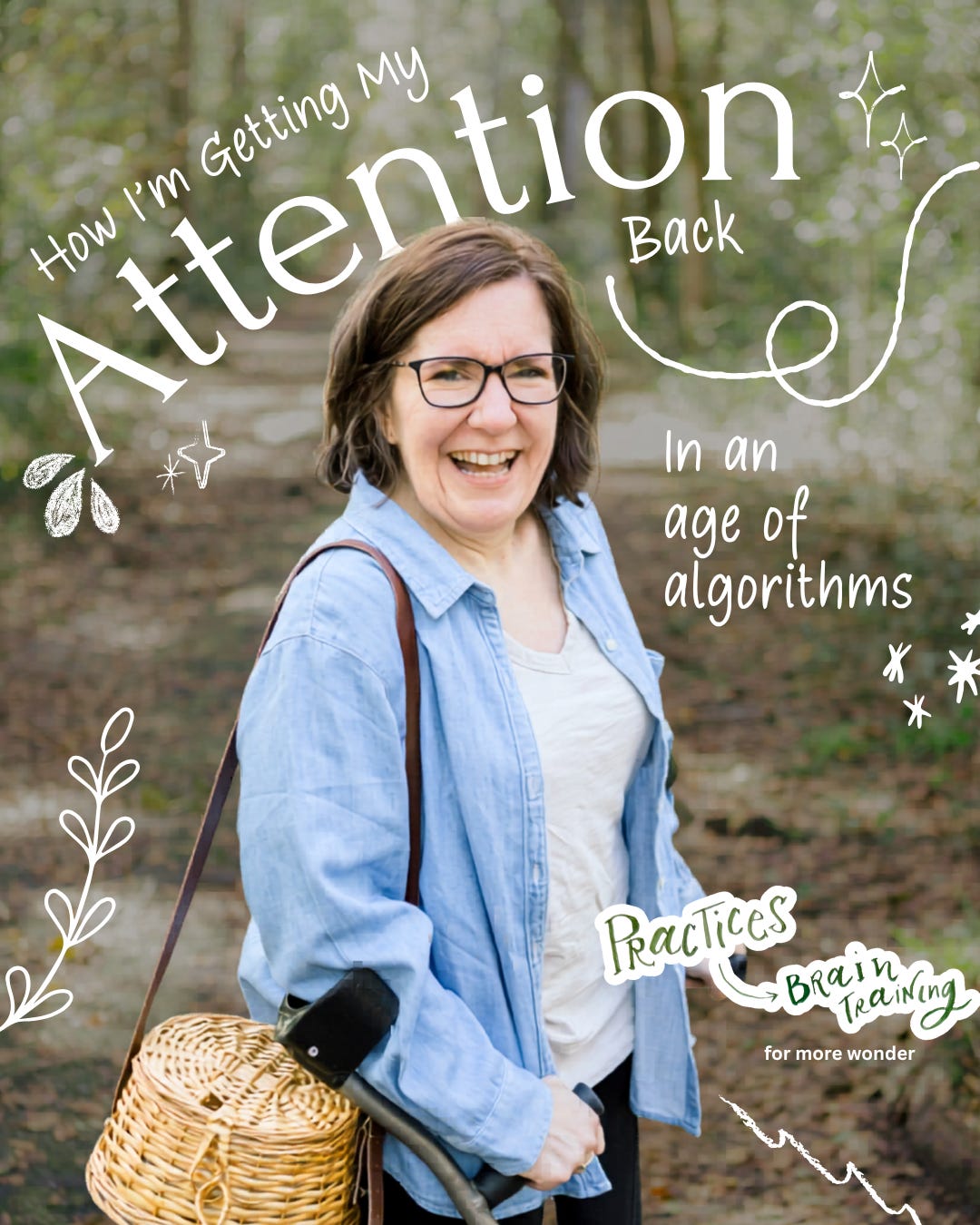
If I am really honest, all of this makes a part of me want to hide in an almost off-grid cabin in the woods. It’s so tempting. But for the vast majority of us, myself included, that’s obviously not a sustainable reality. There are, however, things we can do to help move towards balance. These are some of the things I am currently finding most helpful.
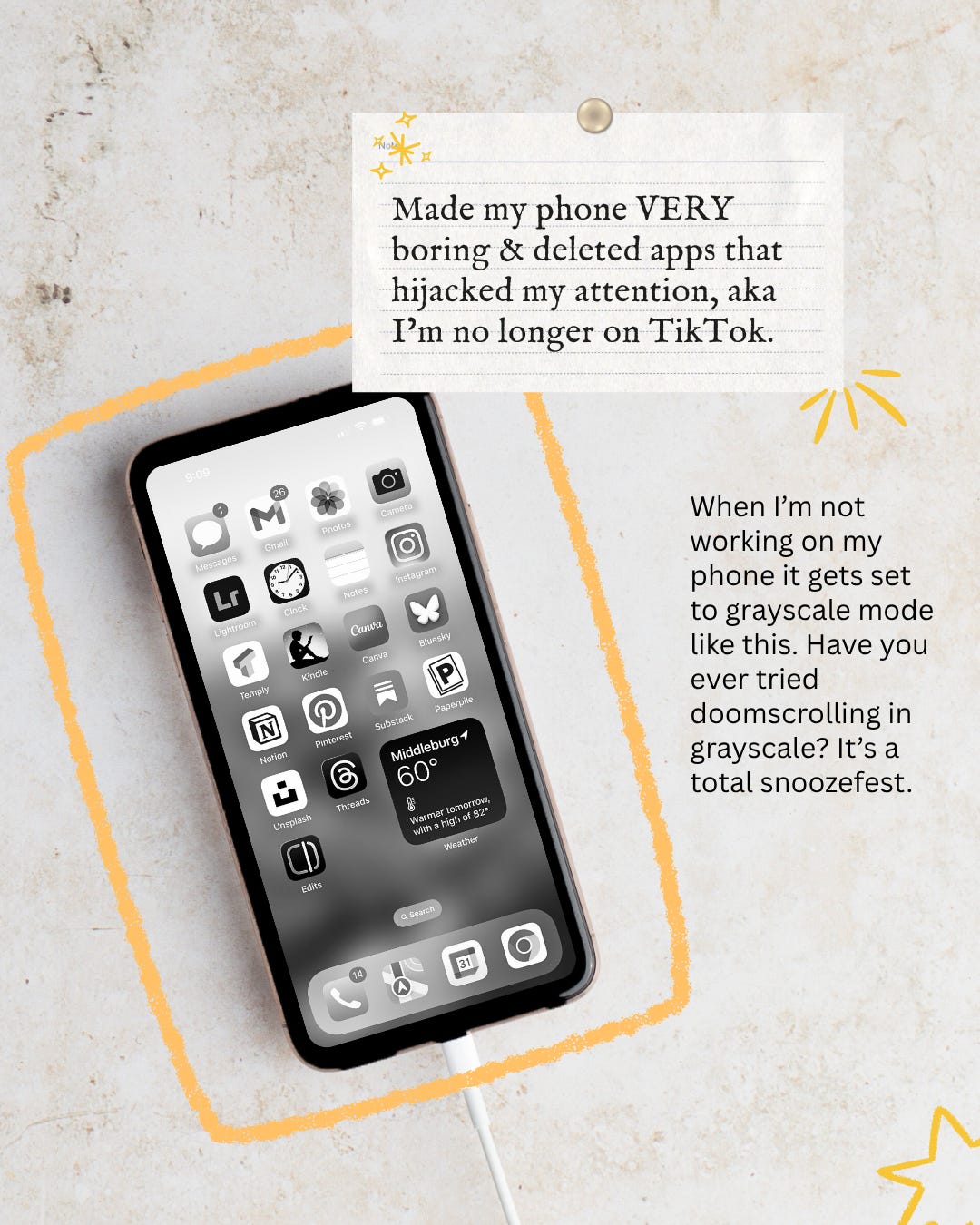
📱 I deleted apps that either extracted my attention or exploited it for someone else’s profit. TikTok and Amazon were my first two to go. While I liked some content, the format of TikTok was horrible for my brain health and my nervous system. It just wasn’t worth it. Amazon got cut because it was too easy to spend money I didn’t need to be spending. I am not here to tell you to delete a specific app. I am here to suggest we need to recognize anything that is depleting and extracting our attention for someone else’s profit.
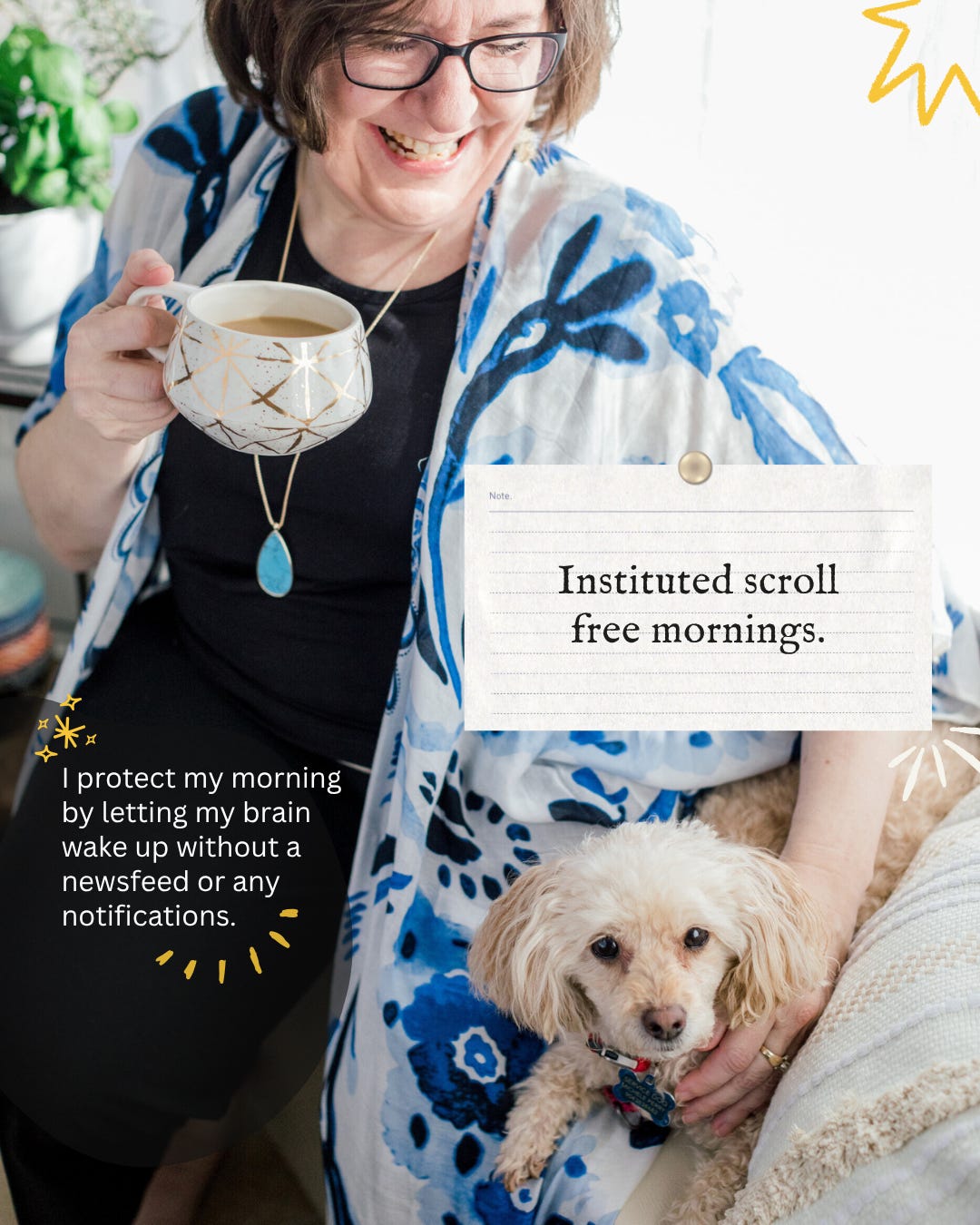
☕️ I have scroll-free mornings. I now read a physical book and write in a journal as I enjoy my coffee. I don’t check my phone until I have to use it to create for work. Also, I turn my phone screen to grayscale when I am not working. Have you ever tried doomscrolling social media in grayscale? It almost put me to sleep!
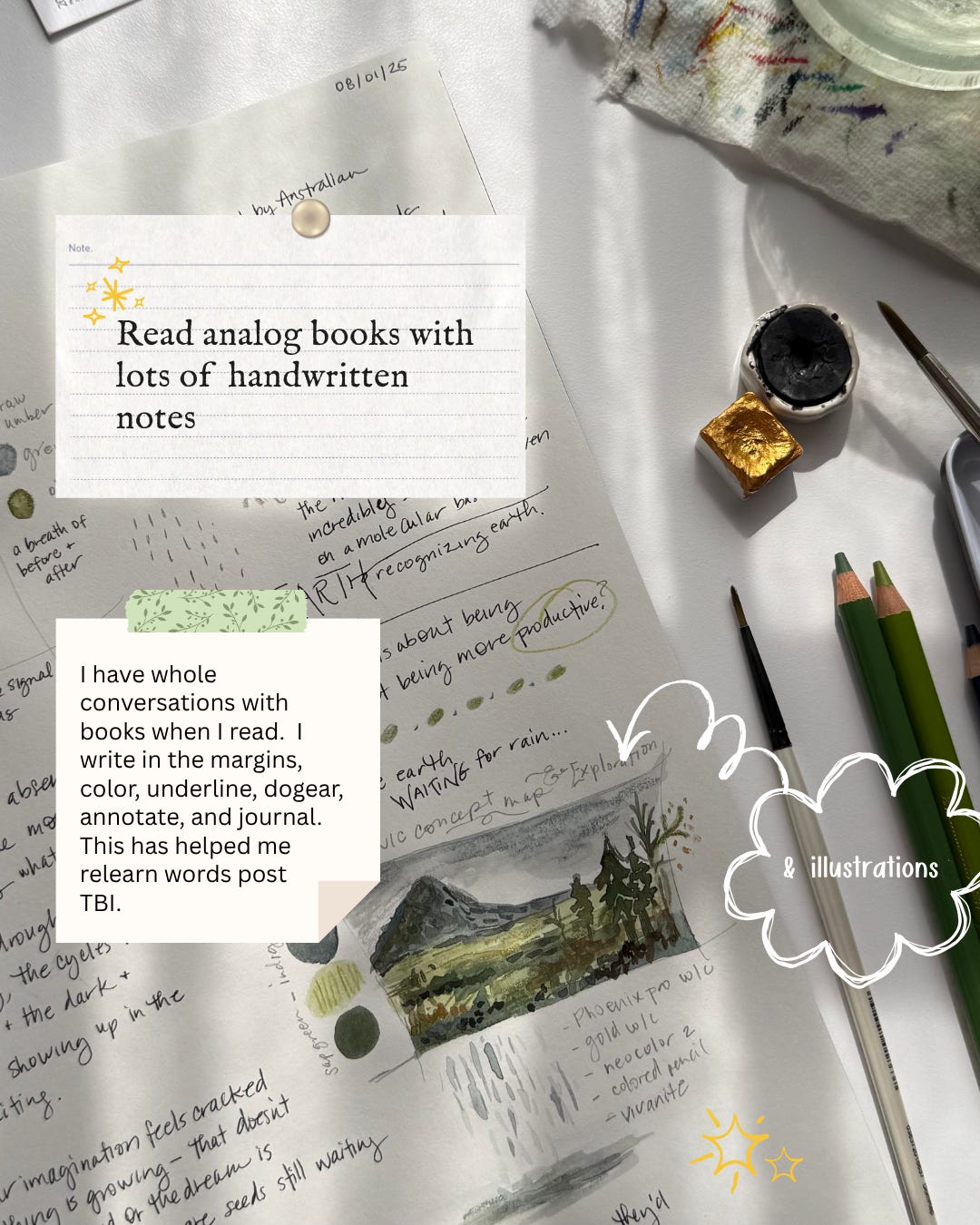
📖 Reading physical books and now writing in an actual notebook every day for journaling. Writing even a few lines each day is one of the most grounding things I can do because I am honoring my own presence as worthy to take up space on a page.
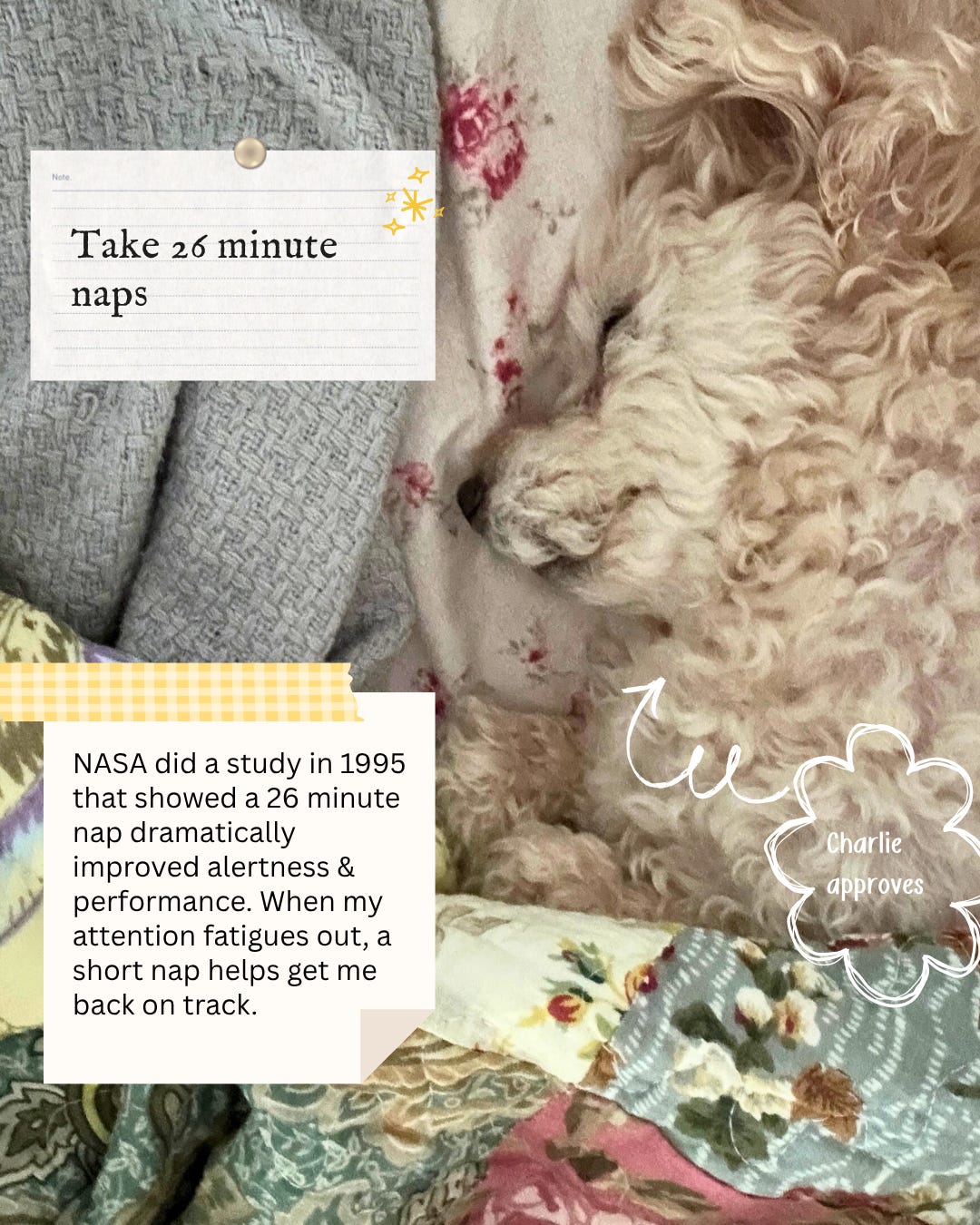
✅ Monotask, micro-blast, and take a nap. Sorry I had to make that rhyme. I work on one thing at a time and when I feel exceedingly stuck, I blast a sheet of paper (usually in my planner) with everything I think I need to get done in the smallest minutia possible. Things that feel so small I can’t not do at least some of them. Also, I take naps now!
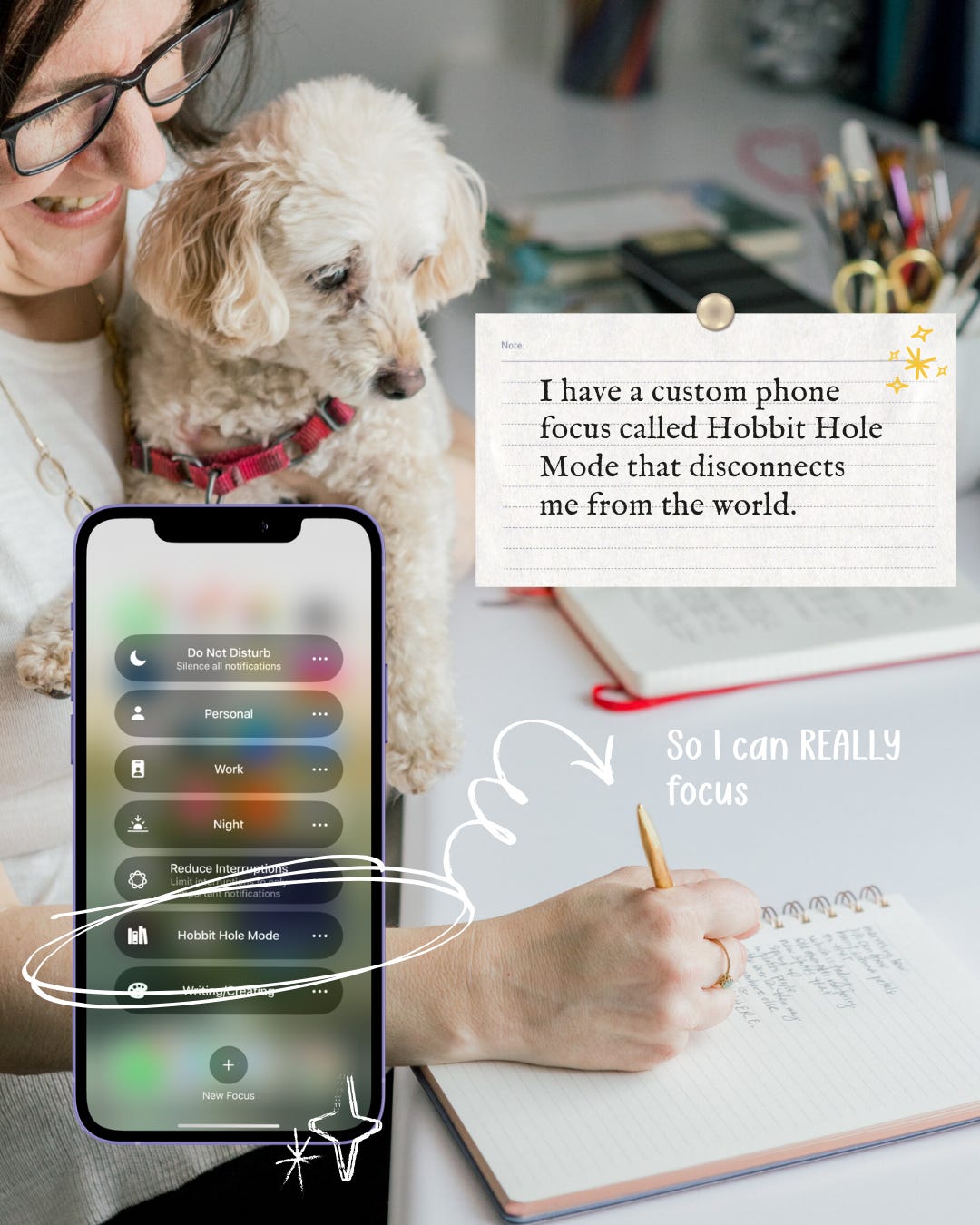
📝 I created a custom focus mode on my phone named Hobbit Hole Mode that turns off every notification—including the badges (the number that appears on an app icon saying how many notifications you have). This let’s me disappear from the world while I write.
💻 I started writing in a program called Obsidian. It is a super stripped-down, free program that just lets me write and organize my thoughts old school. It is analog-adjacent, which means it lives on my actual device with no cloud-based anything or subscription. Of course I have to manually back up everything, but that’s sweetly nostalgic. It returns me to the days of writing in Africa with a kerosene lantern and waning laptop battery.
Getting our attention back is about emotional regulation far more than it is external restriction. Restrictions may offer immediate structure, but they often don’t last for the long term. Whereas internal regulation is what happens when we go on a journey to learn what is healthy for us and our needs. Some things might need to go altogether. Others primarily require boundaries. And these decisions vary vastly between individuals and even between different life seasons.
One thing remains clear. If we want to experience more wonder in our world, reclaiming our attention is a crucial element in being able to find it.
The kind of wonder we talk about here isn’t ethereal aesthetics. It’s about showing up and practicing the art of noticing, training our attention to begin to see the small moments of goodness and beauty that unfold around us every single day. Not as a way to escape or bypass hard realities, but rather as a resilience strategy to make it through them.
So my friend, what is your attention stretching you towards today?
I’m so grateful you’re here.

PS. If this has been helpful please share and restack this to help grow our community. And if you like weekly creative prompts (as well as our extensive archives) and access to upcoming audio versions of me reading (and chatting about) some of my written posts, consider becoming a paid subscriber.
Contrary to popular opinion, the giveaway to AI-generated content isn’t the enthusiastic overuse of the beloved em-dash. Rather, there is a certain cadence and parallel structure that once you see, you will see everywhere. It’s not this. It’s that. You’re not failing. You’re flying.
This is exactly where I am now. From your 1st sentence I was nodding and screaming “YES” (internally anyway). I think of all the I achieved before there was an invasive electronic machine attached to my hands. And even simpler than that, spending time in silence without consent noise. Thanks so much for this post nice to see it all written out in actual thoughtful words
So helpful, thank you for sharing with us!